
Social Media
Is social media always harmful?
Tweens and teens · 5 minute guide · Reviewed July 2026
What to know
The essentials
- The same platform can be supportive for one child and distressing for another.
- Content, context, developmental stage, and design matter—not only minutes online.
- Features such as autoplay, streaks, public metrics, and constant notifications can make stopping harder.
What to notice
Look for patterns, not one imperfect moment.
- 01Mood changes after using a particular app
- 02Sleep, school, friendships, movement, or hobbies being crowded out
- 03Strong distress when access is interrupted
- 04Repeated comparison, body-image concerns, or fear of exclusion
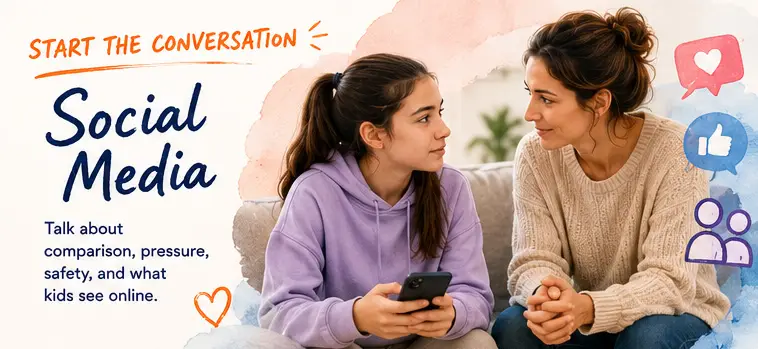
The useful question is not whether every online experience is good or bad. It is what this experience is doing in this child’s life.
What to do next
Begin with one manageable step.
- 1
Ask your child which parts of online life feel connecting and which feel draining.
- 2
Turn off nonessential notifications and remove devices from sleep routines.
- 3
Choose one platform or pattern to review together before changing everything at once.
What to say
Start curious. Stay calm.
“What do adults misunderstand about the apps you use?”
“Which parts leave you feeling better—and which leave you feeling worse?”
“If you could redesign one feature, what would you change?”
The full picture
More context when you need it.
A useful family conversation makes room for both benefits and risks. Beginning with fear or a blanket judgment can make it harder for a young person to disclose what is actually happening.
The goal is not to prove that every online experience is harmful. It is to recognize when a product, community, or habit is no longer serving the child and to respond before the pattern becomes entrenched.
Sources and review
Where this guidance comes from
This guide was reviewed in July 2026. Links open the current source so families can see the full guidance.